An Essay Toward a Hermeneutical Re-reading of the Narrative of the Offering
Preface: When the Symbol Outlives Its Meaning
In reality, the celebration that we now call the “Festival of Sacrifice” may never have been intended to commemorate an attempted human immolation attributed to Abraham. In fact, the very fact that we now refer to it by this name already reveals how a symbol can outlive its meaning.
For, at its heart, it is not so much a festival of sacrifice as it is a festival of offering, sharing, and circulation.
As we mentioned in our reflection on the Hajj, religious symbols sometimes survive the living understanding that gave birth to them. The form remains. The gesture remains. Yet the deeper philosophy that once animated these practices gradually fades away until it becomes almost invisible.
Within the context of the Hajj and the great human gatherings that accompany it, the offering fulfilled, above all, a social, human, and spiritual function of considerable importance. It participated in a broader logic of circulation of resources, hospitality, and collective sharing.
We should not forget that in ancient times—as is still the case in many rural societies today—meat was rarely sold as a commodity. Living animals could be bought and sold, but meat itself circulated primarily through gift-giving, offering, and sharing.
The offering thus became a way of feeding others, honoring guests, supporting those in need, and strengthening the bonds that unite a community.
Viewed from this perspective, the practice belongs far more to a form of social and civilizational intelligence than to a sacrificial logic in the violent or expiatory sense of the term. It reflects a prophetic wisdom seeking to create concrete opportunities for encounter, redistribution, solidarity, and human fraternity.
The offering therefore becomes an act through which life circulates. An act that nourishes bodies. An act that nourishes relationships. An act that allows abundance to flow rather than remain concentrated in a few hands.
Perhaps it is precisely this that we have gradually forgotten as the symbol of sharing was transformed, within our collective imagination, into the mere repetition of a bloody sacrifice.
For when a symbol outlives its meaning, it may continue to be practiced for centuries. Yet it gradually ceases to produce that for which it was originally instituted.
And it is precisely this question that will serve as the starting point of the reflection that follows. For before asking what Abraham saw in his dream, perhaps we must first ask what we ourselves have ceased to see in our symbols.
Part One: Why Revisit This Narrative?
The Law of Necessity
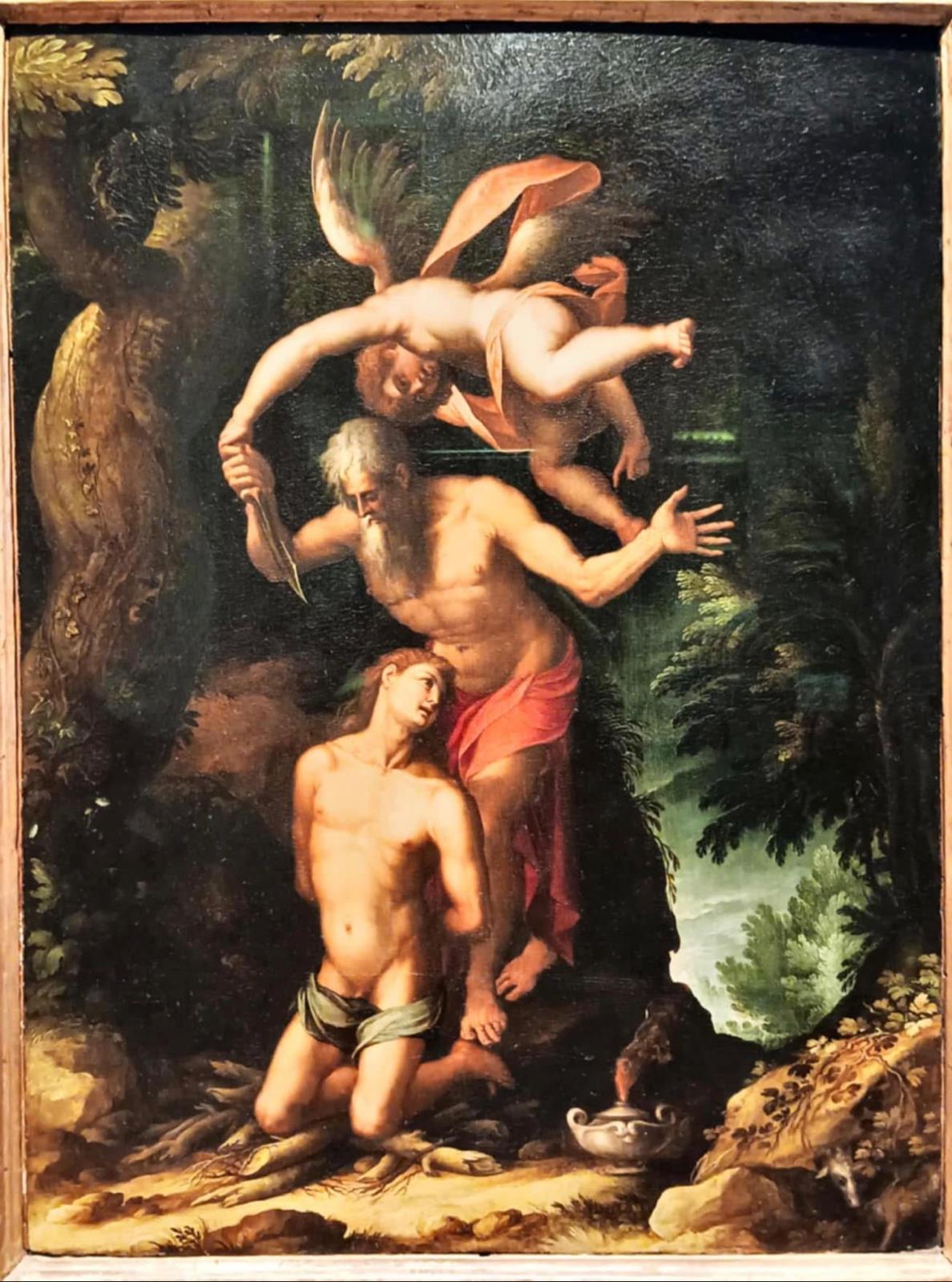
The story of Abraham’s holocaust—or the holocaust that Abraham was allegedly commanded to perform: offering his son as an offering, burning him as a holocaust, presenting him to God—is a story found in the Bible, in the Book of Genesis, with numerous details. The text explicitly states that the son in question is Isaac.
This story was later adopted within Islamic traditions, often in a form almost identical to the biblical account, with one difference that may seem minor to some, yet becomes highly significant for those concerned with questions of identity: the child would be Ishmael rather than Isaac.
It should also be noted that a minority of Muslim scholars saw no problem in maintaining that the child was Isaac. Some even defended this position explicitly.
The episode also appears in the Qur’an.
In its general structure, the narrative closely resembles the one found in Genesis. Yet, as is often the case with the Qur’anic text, multiple levels of interpretation remain possible.
Here we are dealing with a narrative that has reached us in its original language. In other words, we still have access to the text in the very language in which it was communicated. This makes it the only version of the story to which we can truly return in its original expression—provided that we activate the necessary linguistic keys and explore the various semantic possibilities that the words themselves continue to offer.
It is entirely possible that the biblical text, in its original language, also contained a similar openness. Yet through successive translations, a particular understanding was gradually selected, then fixed, until it became the dominant reading.
The same phenomenon occurred with the Qur’an. A particular interpretation progressively established itself within the commentarial tradition. Yet we still have access to the language itself. We still possess the possibility of returning to the text as though we had never read a translation, a commentary, or an inherited interpretation.
We can return to the text with a living knowledge of Arabic.
With the richness of possibilities that the language offers.
With all the meanings that a single word may carry when approached freely.
But before anything else, as I explained in a previous article when presenting my method, I never question a narrative unless it becomes necessary to do so.
I do not challenge a story, an interpretation, or an inherited understanding simply because another reading is possible.
I do not seek originality for its own sake.
I do not seek contradiction for the sake of contradiction.
I do not seek to deconstruct what is functioning.
I only question an interpretation when it produces a real problem.
And I would go even further: when it produces serious problems.
This principle is what I call the Law of Necessity.
In the present case, I believe that such a necessity exists.
I believe it has become legitimate to reinterpret these verses, to search for an alternative meaning, and to examine the possibility that the biblical narrative as it has reached us may have undergone certain distortions—or at the very least, a gradual narrowing and rigidification of its meaning.
I also believe that traditional explanations have followed a problematic path, particularly because they often assumed that this was exactly the same story as the one found in the Bible. They naturally reproduced the biblical account as it was available to them through the translations they possessed. For even the great Arab scholars did not have access to this story in its original language.
We can all agree that these narratives go back to a period that predates classical Hebrew itself.
Abraham was not Hebrew.
And Abraham did not speak Hebrew.
His language most likely belonged to a linguistic world closer to ancient Syriac or Aramaic traditions.
Hebrew, as we know it in its classical form, would only begin to emerge much later, after Moses. And we are certainly not speaking here of modern Hebrew.
Consequently, when a narrative passes through multiple languages—from an ancient language into Hebrew, and then into other languages still—it becomes entirely possible for meanings to shift, transform, or become fixed.
Semantic shifts may occur.
Nuances may disappear.
Certain possibilities may be forgotten.
And a particular interpretation may eventually occupy the entire field.
This is precisely what often happens when an ancient narrative ceases to be read in its original language. The words remain. But the horizon of meaning narrows. And what was originally one possibility among many eventually comes to be received as an unquestionable certainty.
For this reason, beginning from the Law of Necessity, and from the premise that the Qur’anic text remains—until proven otherwise—an authentic text, I choose to return to that text itself.
I choose to return to the language.
I choose to return to the words.
I choose to return to the possibilities of meaning that those words still carry today. Not in order to impose a new interpretation, but in order to examine whether another interpretation is possible.
An interpretation capable of restoring coherence to the narrative.
An interpretation capable of reconciling the text with human nature.
An interpretation capable of reconciling the symbol with its meaning.
For if such an interpretation exists, then it becomes not only legitimate to explore it. It becomes necessary to do so.
Part Two: The Conditions of an Authentic Ritual
Before going any further in this reflection, I would like to clarify something important. I am not the first to find this story problematic or troubling as it is commonly understood, whether in the Bible or in the Qur’an.
Since the Middle Ages, Sufi masters, Kabbalistic teachers, spiritual monks, and philosophers have already proposed alternative readings of this narrative. Through various hermeneutical approaches, they argued that this story should not be understood as a historical event in the literal sense of the term, but rather as a symbolic narrative—a pedagogical legend intended to convey a teaching.
According to these readings, the story is not about the sacrifice of a child, but about the sacrifice of attachments:
-
Attachment to this world.
-
Attachment to one’s offspring.
-
Attachment to the idea of leaving behind a lineage that will populate the earth.
All these forms of attachment are meant to be transcended by the one who journeys toward the Divine. At a certain stage of the path, they must be offered to the Absolute, left behind, symbolically burned away, so that a greater inner freedom may emerge. Since the Absolute is free, and freedom from all attachment is one of the essential characteristics of the Divine, the human being can only truly encounter the Divine by liberating himself from whatever chains him inwardly.
It is a beautiful interpretation. Absolutely. And in any case, the hermeneutical meaning of the story remains, in my view, the meaning that should take precedence.
Yet I also believe that further work remains necessary in order to avoid a certain ugliness in the apparent meaning of the narrative. Or at least to avoid the problems that this apparent meaning can produce.
For we know that the majority of human beings do not experience their relationship with the Divine primarily through contemplation or inner experience. Most people encounter the sacred first through religion, morality, and society. They encounter the apparent meaning long before they encounter the deeper one. And this is precisely why it is so important that the moral vision produced by a narrative be healthy, coherent, and well constructed.
Yet when it is read literally, religiously, or morally, the story as it is commonly understood raises several difficulties. And before we even arrive at the question of sacrificing the child, a more fundamental question emerges: What is a true ritual? What is a ritual within an authentic spiritual path? Within a path connected to the Divine?
And not within a logic of sorcery or paganism, where one seeks to make pacts with hidden forces that desire to control human beings, or with which human beings themselves seek to enter into a transactional relationship based on blood prices, strange offerings, or practices that bring no genuine benefit.
According to my research, and according to what I propose here, an authentic ritual must satisfy several conditions.
The first is that it must be pure. The Divine is pure. The Divine is clean. And what we offer to the Divine must reflect that purity. One cannot offer something impure to the Divine. One cannot defile oneself physically or morally in order to perform a ritual. One cannot use impurity as a means of approaching the Divine. On the contrary. Every authentic ritual must be grounded in something healthy, clean, and worthy.
A ritual must also be appropriate. It must be adapted to the culture of the community concerned. To its level of consciousness. To the historical stage through which it is passing. To the age of the person. To their condition. To their strength. To their actual capacities. A ritual cannot be disconnected from human reality. It must be suited to the human beings to whom it is addressed.
It must also be beautiful. For a ritual consists precisely in offering something beautiful. Its deeper function is to remind the earthly world—including our own bodies—of something of the beauty of the spiritual world and the beauty of the soul. In reality, ritual is an opportunity given to the spirit or the soul so that they may share with the body something of what they experience. A ritual is a form of embodiment: the incarnation of a sublime meaning within a material form. And we can surely agree that any attempt to materialize a higher meaning should produce a beautiful experience. It should be carried by art. It should be carried by beauty.
A ritual must also possess symbolic power. It must be rich in meaning. For its purpose is not to imprison us within the gesture itself. Every gesture should point toward a deeper reality. Every gesture should carry an inner force. Every gesture should remain a doorway, never a prison.
A ritual must also remain simple. For when a ritual becomes excessively complex, we risk becoming obsessed with its mechanics and forgetting its purpose. The form then begins to devour the meaning. And the symbol begins to outlive that which it was meant to reveal.
In summary, an authentic ritual must be:
-
Simple;
-
Beautiful;
-
Pure;
-
Rich in meaning;
-
Appropriate.
But I would add one final condition. The one I consider the most important: an authentic ritual must never violate the laws of nature.
Among the most fundamental of these natural laws are:
-
Not killing the innocent;
-
Not destroying something useful;
-
Not wasting resources in an action that produces no benefit;
-
Not corrupting;
-
Not doing what is vain or meaningless.
To slaughter a sheep, a chicken, or any other animal only to throw it into a fire and watch its smoke rise toward the sky—without sharing its meat, without feeding a human being, a poor person, a traveler, or even another animal, without producing any tangible benefit—seems to me incompatible with the very idea of a divine ritual.
Such a ritual would be devoid of any earthly usefulness. Devoid of any beneficial dimension. A ritual that destroys without bringing anything into being. According to my criteria, such a thing cannot be a ritual inspired by the Divine.
For I find it impossible to imagine that the Divine—which is beneficent, which is blessing, and which always acts in the direction of benefit—would ask human beings to perform a ritual consisting of destroying something useful, severing a beneficial bond, or killing an innocent being in order to achieve spiritual elevation.
I believe it is very dangerous to believe otherwise.
And it is precisely from this question that we can now return to the story of Abraham. For if an authentic ritual cannot contradict the fundamental laws of life, then one question becomes unavoidable: What are we really reading when we read the story of the Offering?
Part Three: When Obedience Replaces Understanding
We can measure the damage that a flawed understanding of ritual is capable of producing. We can see how certain interpretations become dangerous to human life.
Very often, religious readings extract from this story a simple moral lesson: Nothing should be more precious to us than God. Presented in this way, the statement appears noble. It even appears self-evident. Yet depending on how it is understood, it can become extraordinarily dangerous.
For if this idea is detached from any reflection on benefit, wisdom, human nature, and the fundamental laws of existence, it can be used to justify almost anything:
-
If God asks us to take our own life, then we will take our own life.
-
If God asks us to take the life of our spouse, then we will take the life of our spouse.
-
If God asks us to leave our spouse in the desert with her child, then we will leave her in the desert with her child.
-
If God asks us to slaughter our son, then we will slaughter our son.
-
If God asks us to kill our neighbor, then we will kill our neighbor.
-
If God asks us to invade a people's land and drive them from it because that land has now been promised to us, then we will do so.
-
And if God asks us to kill everything living on that land after occupying it—the sheep, the dogs, the cats, the babies, the women, the elderly—then we will do that as well.
-
If God asks us to sever ties with our parents, then we will sever ties with our parents.
-
If God tells us that we are superior to others and that we must colonize the world in the name of that superiority, then we will do so.
-
And if God tells us that because of a sin committed by our ancestors we were born into a caste of untouchables, that we must accept our condition, never seek liberation from it, and consent to our inferiority for the rest of our lives, then we will do that too.
You can see the problem. The moment obedience becomes the supreme value, every other value risks disappearing.
Intelligence disappears. Discernment disappears. Responsibility disappears. Conscience disappears. And the human being gradually ceases to be a partner in meaning and becomes merely an executor.
Yet this logic is precisely the opposite of what we observe among philosophers, seekers of truth, and the great spiritual masters. For them, the central value is not obedience. The central value is the quest, the search, the questioning, the understanding, and the desire to see clearly.
Part of the problem also stems from a certain way of understanding expressions such as: سَمِعْنَا وَأَطَعْنَا (Samiʿnā wa-ataʿnā), often translated as “We have heard and we have obeyed.”
In some readings, this phrase eventually comes to mean: “Whatever is demanded of us in the name of God must be carried out without question.” Even if we do not understand its meaning. Even if we do not perceive its wisdom. Even if we cannot see any benefit in it.
Why? Because we are said to be limited beings, beings incapable of comprehending the realities of mystery. Blind belief then becomes the central value. And indeed, this is often how the matter has been understood. This understanding gradually established itself within the Abrahamic traditions to the point that, for many people, it became the very definition of the journey toward God. Sometimes even the definition of al-ʿibāda itself.
Jews, Christians, and Muslims alike then find themselves speaking of “belief” and referring to the followers of a spiritual path as “believers.”
-
Believing becomes more important than understanding.
-
Believing becomes more important than discernment.
-
Believing becomes more important than seeing.
-
Believing becomes more important than seeking.
And from that point on, it is no longer necessary to understand why something is good. It is enough simply to believe that it is. If God says: “Kill a child,” then we will do it. And we will do it without question. Worse still: it may even be considered a virtue.
Doubt becomes a weakness. Questioning becomes a lack of faith. Hesitation becomes a spiritual deficiency. To be a strong believer, one need only obey. Without understanding. Without examining. Without questioning.
Yet this is precisely what human beings have always claimed throughout history to justify their actions. It is what some Israeli soldiers may invoke when they believe themselves to be acting in the name of a religious promise. It is what groups such as the Islamic State, in some of its contemporary manifestations, as well as other extremist movements throughout history, have invoked. It is what fanatical crowds have invoked when they burned books, persecuted thinkers, or attacked scholars.
It is also what some people may invoke today when they attack spiritual teachers who propose alternative perspectives: by tarnishing their reputation, repeating unverified stories, spreading unfounded accusations, or attacking without restraint.
The mechanism is always the same. The truth is assumed to be already known. Reflection becomes unnecessary. Examination becomes unnecessary. Discernment becomes unnecessary. All that remains is action.
And it is precisely here that we rediscover the importance of the sixth criterion of ritual: an authentic ritual must be beneficial. It must be intelligible. It must produce a real usefulness within the earthly world.
For the moment we stop questioning the benefit contained within an action, we open the door to every deviation. We open the door to every form of violence. We open the door to every justification.
And that is precisely why the question of Abraham’s offering cannot be approached as a simple religious anecdote. For behind this story lies a much larger question: Can the Divine ask something that profoundly contradicts human nature and the fundamental laws of life?
It is to that question that we must now turn.
Part Four: The Divine Can Only Call to What Is Beneficial
A ritual must possess a useful and beneficial dimension for the human being. Even if it is only to perfume a home. Even if it is only to add beauty to a place. And it must do so without excess. Without waste. Without allowing that beauty to be built at the expense of feeding the poor or meeting the genuine needs of human beings.
A ritual must remain in harmony with the earthly interests of human beings. This statement may seem simple. Yet it stands in contradiction to a certain way of understanding spirituality.
For one of the problems produced by some religious interpretations is precisely that they present earthly existence and the natural interests of human beings as though they were opposed to the Divine. As though heaven and earth were pursuing two different projects. As though human beings had to choose between their nature and God. As though the path toward the Divine necessarily required renouncing what is good for life.
Imagine, then, the psychology that such a worldview can produce. Imagine a human being who, by nature—a nature placed within him by the Divine Himself—aspires to do what is beneficial:
-
To cultivate a garden.
-
To make a field flourish.
-
To found a family.
-
To build a home.
-
To experience joy.
-
To know abundance.
-
To develop friendship.
-
To create peace around himself.
Then imagine being taught that, in order to draw closer to God, one must become suspicious of all these things. That one should prefer an austere path. A path hostile to one’s most natural aspirations. A path that is not joyful. A path of tension. A path of conflict. A path of perpetual deprivation.
Gradually, difficulty becomes a virtue. Suffering becomes a virtue. Lack becomes a virtue. Conflict becomes a virtue. Inner warfare becomes a virtue. And the human being comes to believe that he is approaching the Divine precisely because he is doing violence to himself. We should prefer hardship to ease. We should prefer war to peace. We should prefer poverty to abundance. We should prefer illness to health. We should prefer conflict to harmony.
But why? Why would the Divine create a human nature attracted to beauty, peace, health, and flourishing if the path toward Him consisted precisely in fighting those aspirations?
This question seems fundamental to me. For such a vision produces a permanent inner tension. It produces a divided personality. A human being who no longer knows whether to trust his deepest conscience or distrust it. A human being who eventually lives at war with himself.
And it is precisely for this reason that the very idea of a holocaust troubles me. Even before speaking of the child. Even before speaking of Abraham. Even before speaking of the dream.
Let us simply consider the idea of an animal. Imagine that Abraham had been commanded to offer a rabbit, a sheep, or any other animal, and then throw it into a fire so that its smoke might rise toward the heavens. Without anyone benefiting from its meat. Without any human being being fed. Without any poor person receiving nourishment. Without any animal benefiting from it. Without any concrete good resulting from it.
Why? What is the benefit? What is the purpose? What is the meaning?
Such a practice becomes waste. And every healthy human nature spontaneously perceives something ugly in that image. Something incomprehensible. Something profoundly out of harmony. If somewhere there exists a human being dying of hunger—or even an animal dying of hunger—while I am deliberately burning useful food, then something is wrong. Something is fundamentally dissonant.
At that level alone, the very idea of a holocaust as it appears in the traditional narrative seems problematic to me. And I reject it entirely.
For the Divine is beneficent, and the Divine can only call to what is beneficial. This sentence probably summarizes this entire chapter: The Divine is beneficent. And the Divine can only call to what is beneficial.
Only the absurd demands absurd things. Only the malevolent demands malevolent things. That is precisely why a rite of this kind would seem to me to belong more to a satanic logic than to a divine one.
For when we examine the imagery associated with sorcery or with pacts made with destructive forces, we often find this same characteristic: the acts being demanded produce no real good.
-
They destroy.
-
They corrupt.
-
They invert.
-
They humiliate.
-
They defile.
-
They break.
Slaughtering a flawless black sheep only to bury it where not even a dog may eat from it. Defaming an innocent person. Destroying the life of an innocent woman. Breaking the existence of an innocent child. Distorting reality. Reversing the meaning of things. Lowering what the Divine has elevated. Humiliating what the Divine has ennobled. Murdering human beings. Or, when physical murder is not possible, murdering their character.
We know very well that narratives associated with sorcery often describe rituals of this nature. Descripts of acts devoid of benefit. Acts that destroy without giving birth to anything. Acts that corrupt without healing. And it is often even said, within those narratives, that there must be no real benefit at all. As though benefit itself would cause the ritual to fail.
I leave it to you to explore those worlds if you wish. For my part, I return to a principle infinitely simpler: The Divine is beneficent. And the Divine can only ask for what is beneficial.
Anything that profoundly contradicts life, anything that destroys needlessly, anything that corrupts without producing good, anything that turns suffering into a value in and of itself, deserves to be questioned.
And it is precisely here that a second difficulty emerges. Car even if we were to set aside entirely the question of animal holocaust, there would still remain something far more troubling: the very idea that an innocent child could be sacrificed.
Part Six: The Right to Question the Narrative
You may then say: « Very well. But what, then, is the true story? Are you questioning a narrative established in the Qur’an? The Divine Word itself? Do you really have an interpretation different from the one found almost unanimously in the books? An interpretation that would nevertheless remain in continuity with the biblical narrative, except for the difference regarding which child was chosen to be offered? Would you dare question a story shared by all the Abrahamic traditions? »
I would answer in two parts. First, my dear friends, I would say that the very idea of questioning a narrative as it is presented to us in the Qur’an should not frighten us so much. For the Qur’an itself invites us to question it. An authentic and powerful word—like every authentic human being, like every truly powerful logic—is not afraid of questioning. On the contrary, it welcomes inquiry, examination, and being put to the test. What is fragile fears questions, what is solid welcomes them.
And I, in turn, invite you to question what you are reading here. Challenge my reasoning, examine my arguments, question my conclusions. Look for weaknesses, limitations, and what seems unconvincing to you. Do not insult, do not caricature, do not distort, but come with arguments, counterarguments, and a genuine reflection. I would be sincerely grateful to anyone who truly challenges me. And when I say this, I do not say it as a rhetorical formula, I mean it deeply. For every idea that refuses to be tested eventually becomes a dogma, and every dogma eventually drifts away from life.
This is how I imagine the Divine. The Divine Word, as a manifestation of the Divine Breath—just like the human intellect itself—if it is authentic and powerful, naturally calls for questioning. It asks to be explored, traversed, and understood. This should not frighten us. The Qur’an constantly presents its narratives as signs, and a sign is not a conclusion: a sign is an invitation. An invitation to look, to reflect, and to understand. The Qur’an continually addresses those who reason, those who contemplate, those who observe, those who use their intelligence, not those who are content merely to believe without understanding.
Secondly, we must keep in mind what we have already discussed earlier. The dominant interpretation we find today in the biblical narratives has passed through numerous shifts of meaning, numerous layers of transmission, and numerous interpretive fixations. It should therefore come as no surprise that the original meaning of the story, in its first language, may have been partially lost or profoundly transformed. This is the fate of nearly all ancient narratives. As centuries pass, certain possibilities disappear, certain nuances fade away, and certain readings eventually become exclusive.
Yet it is precisely here that one of the great strengths of the Qur’an lies: we still have access to the language in which it was originally communicated. We still have access to the text in its original expression and to the words themselves. And words sometimes carry far more possibilities than those to which we have become accustomed. We must simply be willing to seek them, to return to the text before returning to the commentaries, and to explore freely the possibilities of meaning that the language continues to offer.
Perhaps then we will discover an alternative meaning. Perhaps we will find a reading capable of reconciling the narrative with human nature, with its intention, and with common sense. I do not claim to possess that reading with certainty nor to hold a final truth. I am merely proposing a possibility that seems more coherent to me, more harmonious, and more faithful to the overall spirit of the narrative.
But before entering directly into that proposal, I would like to return to another story connected to Abraham, a story that has also profoundly shaped our imagination and to which I have already alluded: the story of Hagar, of Sarah, of Ishmael, and of Isaac. In other words, the drama—or perhaps the tragedy—of the Abrahamic family. For if we wish to understand Abraham’s dream, we must first examine another separation attributed to him. Another story that we may have accepted too quickly, and whose apparent meaning may also deserve to be questioned.
Part Seven: The Tragedy of Hagar - A Second Narrative to Reconsider
In the biblical narrative, Sarah, although presented as an exceptional woman, becomes jealous of Hagar and asks Abraham to send Hagar and her son away. Abraham then sends them away. In some readings, he does so because he is obeying a command he has received.
In the popular Muslim narrative, the story takes a slightly different form. Sarah is likewise jealous of Hagar, but God reveals to Abraham that it would be better for all concerned if the two wives and the two families were separated. Abraham then takes Hagar and her son far away, into the heart of the desert, to a place where nothing grows. A place where there is neither water nor food. He leaves a mother alone with her child in a barren valley. Then he turns his back and walks away.
Hagar calls after him:
— “Whom are you leaving us to?”
Abraham does not answer. She repeats her question a second time. The child is there. The child is crying at her feet. And still Abraham does not answer. On the third attempt, she asks him:
— “Is this what God is asking you to do?”
And Abraham indicates that it is. Then Hagar accepts her fate and replies:
— “If this comes from Him, then He will not abandon us.”
The child cries from thirst. Hagar panics. She searches for water. She struggles to save her child. She runs between the two hills of Ṣafā and Marwa. She searches. She returns. She runs again. But she finds no water. Then, when she returns to the place where she had left her child, she discovers a spring bursting forth. According to the popular narrative, the child, striking the ground with his foot while crying, caused the water to appear. Hagar then tries to contain the water as it spreads. And, in her original Egyptian language, she is said to have cried: “Zam, zam, zam…” And that spring, which later became a well, is known to this day as Zamzam.
This story later became one of the foundations of several rites of the Hajj: the running between Ṣafā and Marwa, the water of Zamzam, and several other ritual elements. Yet this story too, as is so often the case, appears in the Qur’an in a far more open and far more ambiguous way than most people imagine.
Perhaps you will say to me: “No, it is not ambiguous. It is perfectly clear.” And I would reply: “Are you certain?” For there is sometimes a considerable difference between what a text actually says and what centuries of storytelling have led us to believe that it says. There are things we have simply absorbed without ever questioning them.
Let us take a very simple example. How old was the child when Hagar and Ishmael departed? Is his age mentioned in the Qur’an? Do we explicitly see in the text that he is a baby? Where do all these details come from? For when we return to the text itself, we essentially find Abraham saying: رَبَّنَا إِنِّي أَسْكَنْتُ مِنْ ذُرِّيَّتِي بِوَادٍ غَيْرِ ذِي زَرْعٍ (Surah Ibrahim, 14:37).
And that is practically all. There is no mention of Hagar. No mention of an infant. No mention of a child abandoned in tears while Abraham walks away. No mention of a mother helplessly watching her child die. So how did all these details become part of our inheritance until they came to be treated as self-evident facts? How did they become so deeply established that nearly all jurists, commentators, and scholars—even those who claim a rigorous attachment to the text—accepted them without serious questioning?
For after all, how is it conceivable that a healthy human being—spiritually, intellectually, and emotionally healthy—would accept the idea of leaving a child crying in the desert? Let us forget, for a moment, that it is his own child. A child. A woman. Abandoned in a barren valley. Exposed to hunger, to thirst, to wild animals, without protection, without food, without water. How could such a thing be considered normal?
What exactly distinguishes this story from others that we immediately condemn when we hear them? When someone says: “How could that man bury his daughter alive?”, we are immediately horrified, and rightly so. But where, exactly, is the difference? To bury a girl alive causes a swift death. To leave a child to die slowly in the desert, before the eyes of his mother, forcing her to witness that suffering hour after hour—would that be any less grave? How could a human being walk past a woman and a child who are perishing and simply continue on his way? And what if that woman were his wife, and that child his own child?
Once again, the familiar answer returns: “It was a trial for Abraham, so that he might detach himself completely from the world.” Do you see? We encounter exactly the same logic, the same structure, the same way of thinking. A logic of dissonance, a logic of contradiction, a logic of war between heaven and earth. As though human closeness had to be sacrificed in order to reach the Divine. As though love had to be destroyed in order to become spiritual. As though compassion had to be suspended in order to prove one’s fidelity.
And it is precisely here that I now return to the narrative of the Offering. For the more I contemplate these two stories side by side, the more a single question returns: Are we certain that we have correctly understood what the text was trying to say? Or have we inherited a reading that gradually transformed fruitful separations into abandonments, and symbols of maturation into narratives of destruction?
It is this possibility that we must now examine. For everything may begin with a single word, a single verb, a single term whose horizons of meaning we may have forgotten. The word: أَذْبَحُكَ (As-Saffat, 37:102).