Is Humanity Capable of Pilgrimage?
We live in a strange age.
Never have there been so many conversations about peace.
Never so many institutions dedicated to peace.
Never so many declarations on human rights.
Never so many summits, conferences, and gatherings devoted to the future of humanity.
And yet:
Never so much anxiety,
Never so much inner fragmentation,
Never so much loneliness,
Never so much fear of the other,
Never so much difficulty in living together.
We have developed extraordinary ways of communicating with one another, and yet we no longer always know how to truly meet one another.
We have built networks, but we have sometimes lost our bonds.
We have learned how to connect machines, but we no longer always know how to connect hearts.
And perhaps the fundamental question is not:
How do we build peace?
But rather:
What kind of human being is capable of inhabiting peace?
For a society never produces anything other than what it already carries within itself.
A humanity that is inwardly fragmented will produce fragmented structures.
A humanity that is inwardly violent will produce violent systems.
A humanity that is inwardly captive will produce captive societies.
I would like to propose a simple idea:
There will be no universal peace without global spiritual and conscious liberation.
⸻
I find it remarkable that we find ourselves today at a moment where several spiritual memories seem to converge.
In the Muslim tradition, millions of pilgrims are living through the days of Hajj and Arafat.
In the Christian tradition, we are in the season of Pentecost.
And Pentecost itself finds its roots in Shavuot within the Jewish tradition.
In various Indigenous traditions, gatherings linked to the cycles of the sun and the solstices also mark moments of gratitude, realignment with the rhythms of the Living, and the renewal of communal bonds.
In various Eastern traditions as well, great pilgrimages bring together human beings from different languages, colors, cultures, and horizons.
And so I wonder:
Why does humanity continually return to pilgrimage?
Why does it continually return to gathering?
Why does it continually return to this strange idea that one must leave one’s home in order to return to one’s dwelling?
Why must we sometimes leave ourselves in order to return to ourselves?
Perhaps there exists within human history a deeper memory.
An intuition that returns again and again:
that the human being must sometimes leave its ordinary center in order to rediscover a greater center.
⸻
We have often understood Pentecost as a miracle in which different people suddenly began speaking a single language.
But perhaps the miracle was not the appearance of a common language.
Perhaps the miracle was exactly the opposite.
Perhaps everyone continued speaking their own language.
But a new quality of presence suddenly made mutual understanding possible.
Perhaps the common language was not a language.
Perhaps the common language was a consciousness.
A consciousness made of:
listening,
openness,
curiosity,
trust,
wonder before difference.
For perhaps communion does not become possible despite our differences.
Perhaps it becomes possible precisely because of them.
In a forest, trees do not become identical in order to live together.
Their diversity is what creates the ecosystem.
And perhaps humanity is no different.
⸻
First Condition: Entering the Space of Imân
From Fear to Trust
We have often reduced Imân to belief. But Imân is not belief.
The root itself opens an entire universe:
Amn
Amān
Amāna
Imân
All of these notions revolve around:
- security,
- trust,
- reliability,
- responsibility.
Perhaps Imân is, before anything else, a habitable space of trust.
No human being can build lasting peace while living inwardly in fear.
For fear:
- wants to control,
- wants to possess,
- wants to dominate,
- wants to exclude.
Trust:
opens,
welcomes,
allows encounter.
A civilization of fear builds walls.
A civilization of Imân builds bridges.
I find this intuition echoed across many human traditions.
Saint Augustine said:
“Our hearts are restless until they rest in You.”
Siddhartha Gautama taught that suffering arises from attachment.
Sufis might speak of nafs.
Psychologists might speak of conditioning.
Human rights advocates might speak of oppression.
Perhaps we are simply speaking about different forms of captivity.
⸻
Second Condition: Healing Inner Fragmentation
Reuniting the Human Being
We have developed technologically advanced societies. But inwardly we are often fragmented.
We think one thing.
We feel another.
We say something else.
We do something entirely different.
Peace cannot emerge in a being divided against itself.
Spiritual work may not first be a moral task.
It may first be a work of reunification.
Body.
Soul.
Intelligence.
Emotions.
Presence.
Peace may simply be that moment when the different parts of ourselves stop fighting one another.
⸻
Third Condition: Moving Beyond Closed Identities
When Belonging Becomes a Prison
Much of human conflict arises from the need for belonging.
We identify ourselves through:
religion,
nation,
school,
ideology,
community.
There is nothing wrong with this.
The problem begins when identity becomes a prison.
The Qur’an says:
We created you as peoples and tribes so that you may know one another.
Martin Buber wrote:
“All real living is meeting.”
Peace is not born when I merely tolerate the other.
Peace is born when I no longer need the other to become me.
⸻
Fourth Condition: Relearning Hadra
Inhabiting Presence
Within the Sufi language there exists a beautiful word: Hadra.
It is often translated as presence. But Hadra is more than physical presence.
It is a quality of being.
It is that moment when we stop merely occupying space and become present to the Living.
Perhaps peace is not merely an agreement between individuals.
Perhaps it is a collective Hadra.
⸻
Fifth Condition: Sohba and Adab
Peace as Human Contagion
Sufis also speak of Sohba: transformative companionship.
We have organized conferences on peace. Institutions for peace. Declarations for peace. Programs for peace.
And yet perhaps we have forgotten Sohba.
Perhaps peace is transmitted more through human contagion than through theory.
Perhaps peace is not simply taught.
Perhaps it is breathed.
Perhaps it is tasted.
Perhaps it is absorbed through presence.
There are people whose presence leaves us more agitated, more fearful, more contracted.
And there are people whose presence expands us.
Without words, without doctrines, without arguments, they leave us with more space inside ourselves.
Perhaps the world does not need only experts on peace.
Perhaps it also needs communities of Sohba.
Spaces where human beings remember how to grow together.
⸻
Then there is Adab. It is often translated as politeness or etiquette.
But Adab is much deeper.
Adab is the awareness of the rightful place of things.
Perhaps our crisis is not merely a moral crisis.
Perhaps it is a crisis of Adab.
A crisis in our relationship:
with ourselves,
with others,
with the Earth,
with time,
with the sacred.
We live in a civilization that has become extraordinarily capable of doing things.
But we are not always asking:
What is the right place of things?
What is the right measure?
What is the right rhythm?
What is the right relationship?
Perhaps peace begins when we rediscover Adab.
⸻
Sixth Condition: Fanā’ and Fath
The Dissolution of Inner Prisons
The word Fanā’ sometimes frightens people. It is often translated as annihilation or extinction.
But perhaps Fanā’ is not the disappearance of the human being.
Perhaps it is the disappearance of the prisons of the human being.
The disappearance of:
masks,
fears,
excessive attachments,
compulsions,
inner idols,
conditionings,
closed identities.
We have abolished many forms of visible slavery.
Yet subtle forms of slavery remain:
slavery to fear,
slavery to wounds,
slavery to inherited narratives,
slavery to compulsive desires,
slavery to the need for recognition,
slavery to identity itself.
There will be no universal peace without certain forms of collective Fanā’.
Not the disappearance of humanity but the disappearance of what imprisons humanity.
⸻
Then comes Fath.
We have sometimes understood Fath as conquest. But perhaps the true opening was never territorial.
Perhaps it was always inward.
Perhaps the prophets did not come to conquer the world.
Perhaps they came to open it.
To open hearts.
To open horizons.
To open consciousness.
To open possibilities hidden within the human being.
Peace may begin at the moment when I stop trying to overcome the other and begin allowing something greater to open within me.
⸻
Seventh Condition: Hajj as a Laboratory of Universal Peace
Arafat and Global Consciousness
Hajj may be one of humanity’s greatest experiments in coexistence.
Millions of human beings gather.
Different languages.
Different colors.
Different cultures.
Different histories.
Different social classes.
Different personalities.
Yet for a brief moment something extraordinary happens.
People leave behind:
their distinctions,
their privileges,
their social characters,
their status,
their ordinary attachments.
They enter ihrām. And perhaps ihrām is not merely ritual clothing.
Perhaps ihrām is:
inner disarmament before outer disarmament.
How can we build a peaceful world with human beings who have never learned to put down their inner weapons?
Weapons of fear.
Weapons of pride.
Weapons of superiority.
Weapons of resentment.
Weapons of identity.
⸻
Then there is Arafat.
Perhaps Arafat is not merely a geographical place.
Perhaps it is:
the place of recognition,
the place where the human being recognizes oneself, recognizes the other, recognizes dependence upon the Living.
Perhaps humanity itself is in need of a moment of Arafat.
A moment where we stop defining ourselves by what separates us and begin remembering what connects us.
Perhaps humanity needs a collective pause.
A collective standing.
A collective remembering.
⸻
Conclusion
Peace as a Human Pilgrimage
Perhaps universal peace is not a political destination.
Perhaps it is a pilgrimage.
A pilgrimage of humanity toward itself.
And perhaps the question is no longer:
How do we obtain peace?
But:
How do we become a space where peace can dwell?
For inwardly captive human beings will always create captive societies.
But inwardly liberated human beings may finally become a human Hadra.
When the human being ceases to be a fortress, it becomes a dwelling.
When it ceases to be a border, it becomes a horizon.
When it ceases to be fear, it becomes presence.
Perhaps this is what Salām truly is.
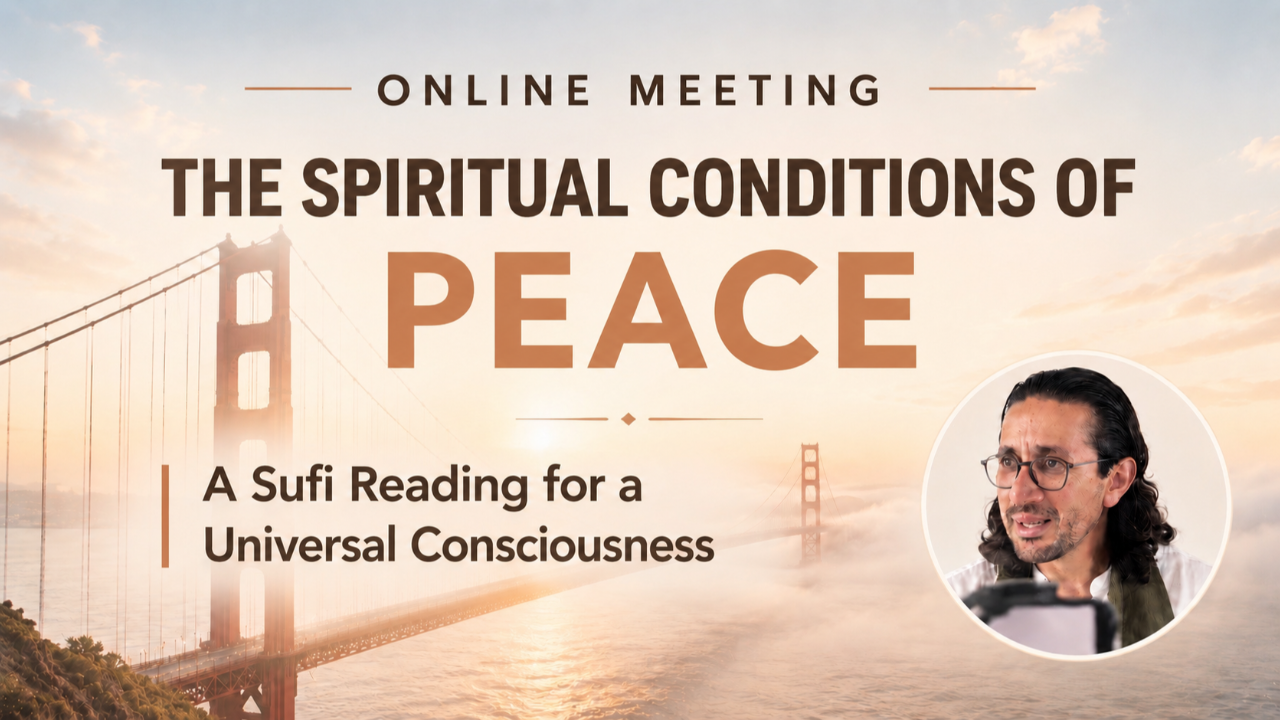
👉To watch the meeting : https://youtu.be/xXtIxRhkrCY?si=hNFuColdeHR1HPAt